When we pair Acts 9 with the gospel of John chapter 6 we might conclude that they are connected by a direct line of logic. In John 6 Peter confesses that Jesus has become the anchor in his life. Other disciples had gone home when the words of Jesus tested them beyond their strength. But Peter confessed his rock-solid commitment with one simple rhetorical question: “Lord, to whom would we go?”
That seems to lead nicely to Acts 9, by which time Peter himself has begun to work the wonders that Jesus had once performed. But something’s missing here, because the line connecting the two stories is not at all direct. Lest we forget, somewhere along the way Peter had denied Jesus three times. Unlike the disciples who simply drifted back to their homes, in one of the most dramatic scenes in the New Testament Peter got angry and ran away. And it’s my guess that this was not the last time when Peter’s faith was shaken to its core.
For better and for worse, Peter’s story is our story, for one simple reason. The recipe for integrity demands self-awareness, a dollop of sacrifice, and not a little pinch of grit. Along the way there are lots of temptations to distract us, but Jesus sticks by us, no matter where the trail leads. Behold, he is with us always — yesterday, today and forever. And best of all, he walks with us, even when we don’t notice.
NOTES
+Today’s post is a variation on the sermon I delivered at the abbey Mass on April 20th. That happened to be our monthly day of reflection in the monastery.
+On April 19th I attended Saint John’s Day, which is an annual dinner that welcomes supporters of Saint John’s University. Unlike our usual custom of inviting soon-to-graduate seniors to speak, this time we invited our four alumni Rhodes Scholars to speak. It was an inspiring event.
+On Sunday afternoon, April 21st, I attended an organ recital in the abbey church, given by Brother Simeon Johnson of Conception Abbey in Missouri. This completed Brother Simeon’s course of studies in the School of Theology/Seminary at Saint John’s, and by it he earned a Master of Arts in Liturgical Music. He certainly earned his new title of Master that afternoon.
+During the past week I was prayer leader at the daily liturgy of the hours.
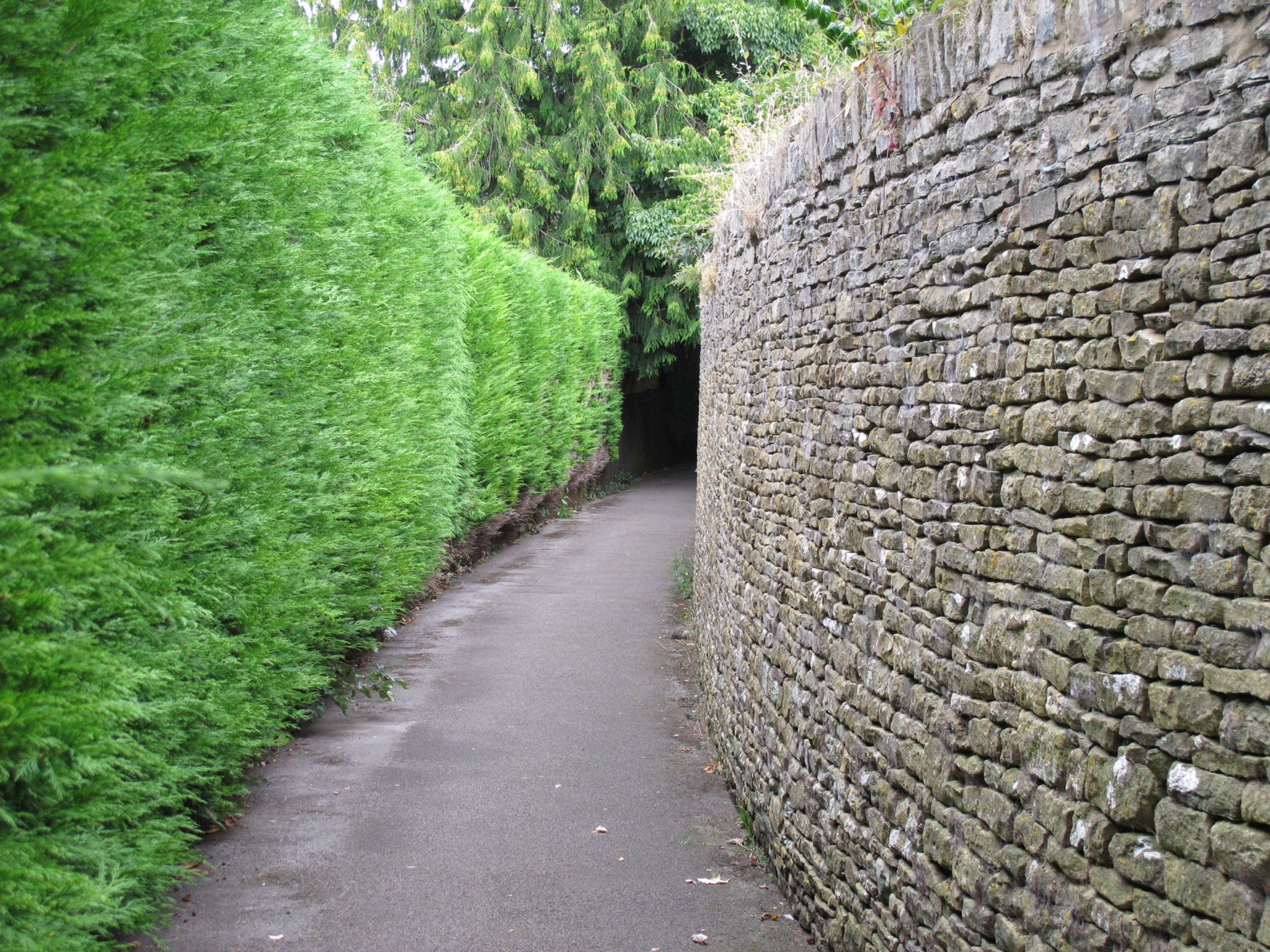
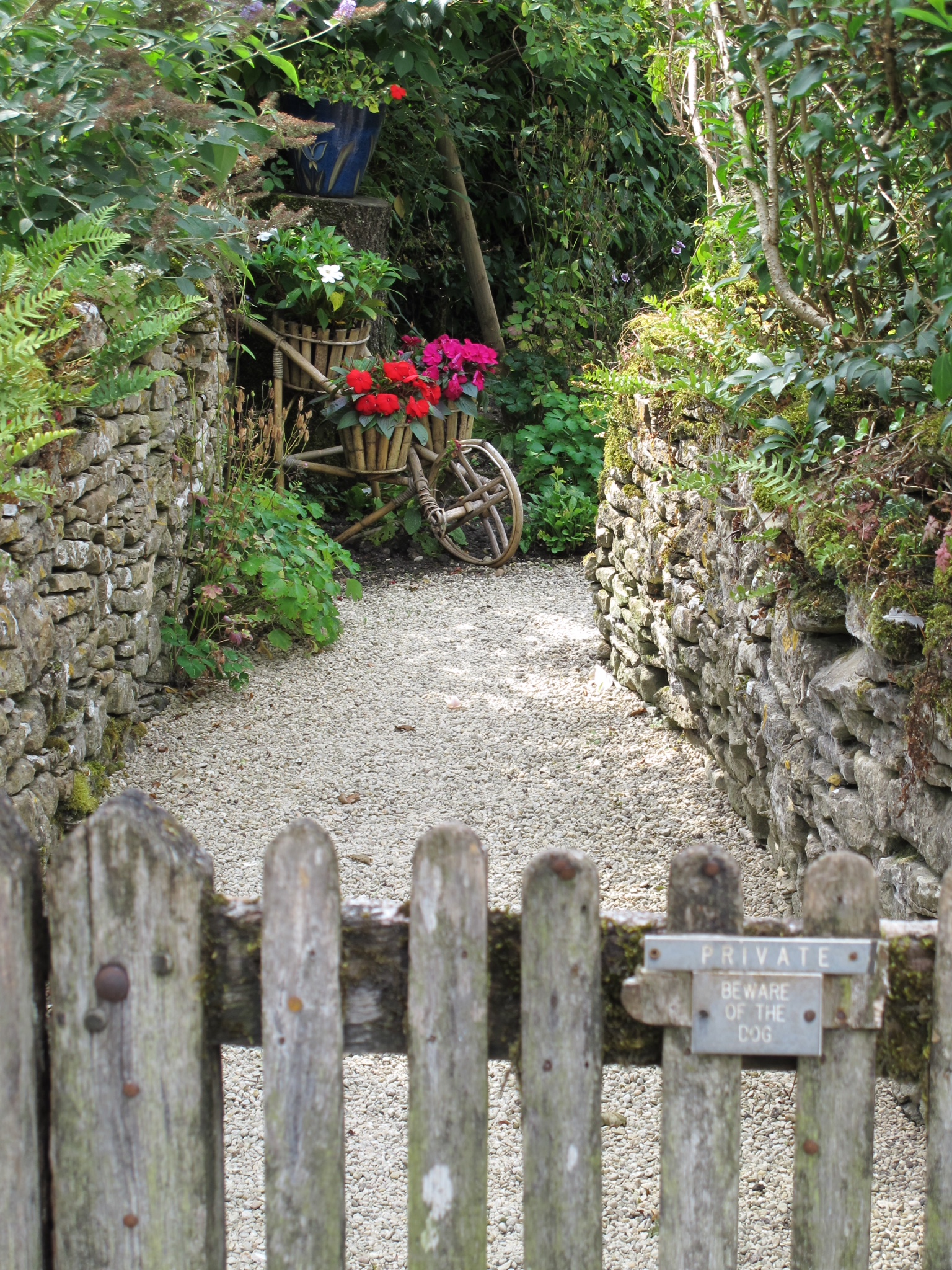
+I’ve always found the pathway to be a wonderful image of life with Christ. Some paths can be lovely and enticing, but each can have its own particular pitfall, as the photos in today’s post suggest. I took these photos years ago during a tour through the Cotswold villages in England.
In the liturgies of Easter we do a quick read-through of the Acts of the Apostles. It’s a great story, in which the disciples confidently charged forward in the business of building a church. But to conclude that the disciples of Jesus knew exactly what to do in every situation would be a big mistake. In fact, there were more than enough moments of agony and indecision.
Jesus did not leave the disciples a handbook with all the answers. Rather, he left them the Holy Spirit, and that Spirit guided them through one challenge after another. It was tough going at times, and I have to wonder how disciples like Peter and Paul handled it all. Were there days when they prayed that the Lord would just leave them alone for a while? I have to believe so. All the same, God seemed not ready to leave them in peace. There was way too much to do; and in the cases of Peter and Paul, it would take two lifetimes to accomplish it all.
The movie The Agony and the Ecstasy recounts the ordeal of the painting of the ceiling of the Sistine Chapel. Pope Julius II had commissioned Michelangelo to do the work, but the project quickly became bigger than either had imagined. In the course of it Michelangelo became the frustrated visionary, while Julius became the equally frustrated patron. In time their visits became tense, until at last Julius came up with the mantra that closed each encounter. “When will you make an end?” To which Michelangelo shot back with an equally testy “When I am finished!”
I’m guessing that there were days when the disciples prayed to God in words similar to those of Pope Julius. Much to their consternation, God answered with words that at first were no comfort. God did not leave them in peace, because God was not yet finished with them.
Truth be told, I’ve prayed those same words of Julius more times than I care to admit. Still, despite my pleas, God keeps nudging me from one tight spot to the next. Is this then the work of the Spirit within me? Perhaps. That’s why it’s so important to keep praying about it, because sooner or later God provides an answer — enigmatic though it might be. When, Lord, will you be finished with me? Every now and again I’ve been able to detect the playful reply from God: “When I am finished.”
NOTES
+Each Monday Abbot Douglas hosts a small group of monks for conversation and dinner, and on Monday the 8th I was among the foursome that gathered in a conference room in the monastery.
+On April 10th I hosted Fr. Michael Ryan and two friends on a visit to the abbey. Fr. Michael is the rector of the Cathedral of Saint James in Seattle, where I have given several retreat days for members of the Order of Malta. In March, at the end of such a retreat, I invited him to stop by if he ever found himself in Minnesota. A month later he did, much to my delight.
+On April 10th I presided at the abbey Mass, and today’s post is a much-reworked version of the sermon I delivered that day.
+On Saturday evening, 13 April, I began a week as prayer leader for the liturgy of the hours in the abbey.
+The landscape at this time of year is in that in-between stage, with hints of green in the lawns accented by the brown bare branches of the trees. Still, it has its own special beauty, as the top photo suggests. This is the one time of year when it is easy to pick out what is reputed to be the first reforestation project in Minnesota history. Following a major storm in 1894, the monks planted a stand of white pine, which shows clearly in the winter and spring. I took the first three photos on April 8th, the day of the much-hyped solar eclipse. We had had several days of overcast, and so we were not particularly interested in the 40% darkness of the eclipse. We were looking forward to the 60% sun, which did not materialize. The photo at bottom was taken on the 9th, which would have been a much better day for an eclipse.
Lent has been over for eight days now, and it’s time to share a secret. I like Lent. I always have. But I’ve always wondered this: if you really like something, can it still count as penance?
One reason I love Lent has to do with childhood memories. Lent was the only time of the year when our family went to church on both a Wednesday and on an evening. Like most people in our parish, we drove in the darkness of a winter’s night to crowd into the church. There we prayed the stations of the cross, sang hymns and meditated on short passages from the scriptures. It was ritual at its best, and the experience created a strong sense of community. And because we did this for only a few weeks during the year, it has left a trove of clear rather than blurred memories.
My second secret is no secret to my confreres who also love fish. I grew up in a family in which meat and potatoes reigned supreme, but for me fish was the real treat. On Fridays in Lent my mother prepared salmon loaf, tuna casserole and toasted cheese and tuna melt sandwiches. Those became my favorite meals not only for the rest of the year but for the rest of my life. But during Lent I indulged in them with a sense of purpose. There was nothing penitential about it, but I also knew it was Lent.
Life in the monastery changed a lot of the liturgical regimen that I grew up with, and to Friday it added Wednesday as days of abstinence. Lent in Minnesota also added fish like walleye and herring, of which I knew nothing as a kid. They’re now also on my list of preferred “penances”, but I never take them for granted. That said, the special Lenten liturgies and the days of fast and abstinence shape life in our monastic community, and not just because they are unique to this season. All the same, I’m still left with one question: does my enjoyment of all this actually diminish the impact of Lent?
The answer for me is a resounding “no”. As I’ve come to appreciate it, Lent is not just a matter of giving up stuff. As much as anything it is a regimen of traditions and rituals that have the power to shape and inspire us as individuals and as communities. To my way of thinking, if Lent can accomplish even a smidgeon of that, then it has value beyond measure.
Lent then is a time to remind ourselves of our special character as people of God. Far from being some sort of sin to enjoy Lent, it’s well worth it if we savor every moment for the insight into life that Lent can give to us. That’s why I’m already anticipating next year’s Lent. However, for the moment I’m contenting myself with Easter, because it’s time to celebrate the risen Lord. One season at a time, please!
NOTES
+On Easter Monday, April 1st, many of the monks enjoyed the traditional Emmaus walk, which took them on a three-mile walk to breakfast at the home of the mother of Father Lew, the director of formation in the monastery. It was bit too cold and windy for me, so I denied myself this special treat.
+On April 3rd I concelebrated at the funeral Mass for Richard Brasket, held at Immaculate Heart of Mary Church in Minnetonka, MN. While I did not know Richard, I did get to know both his son and grandchildren during their student years at Saint John’s.
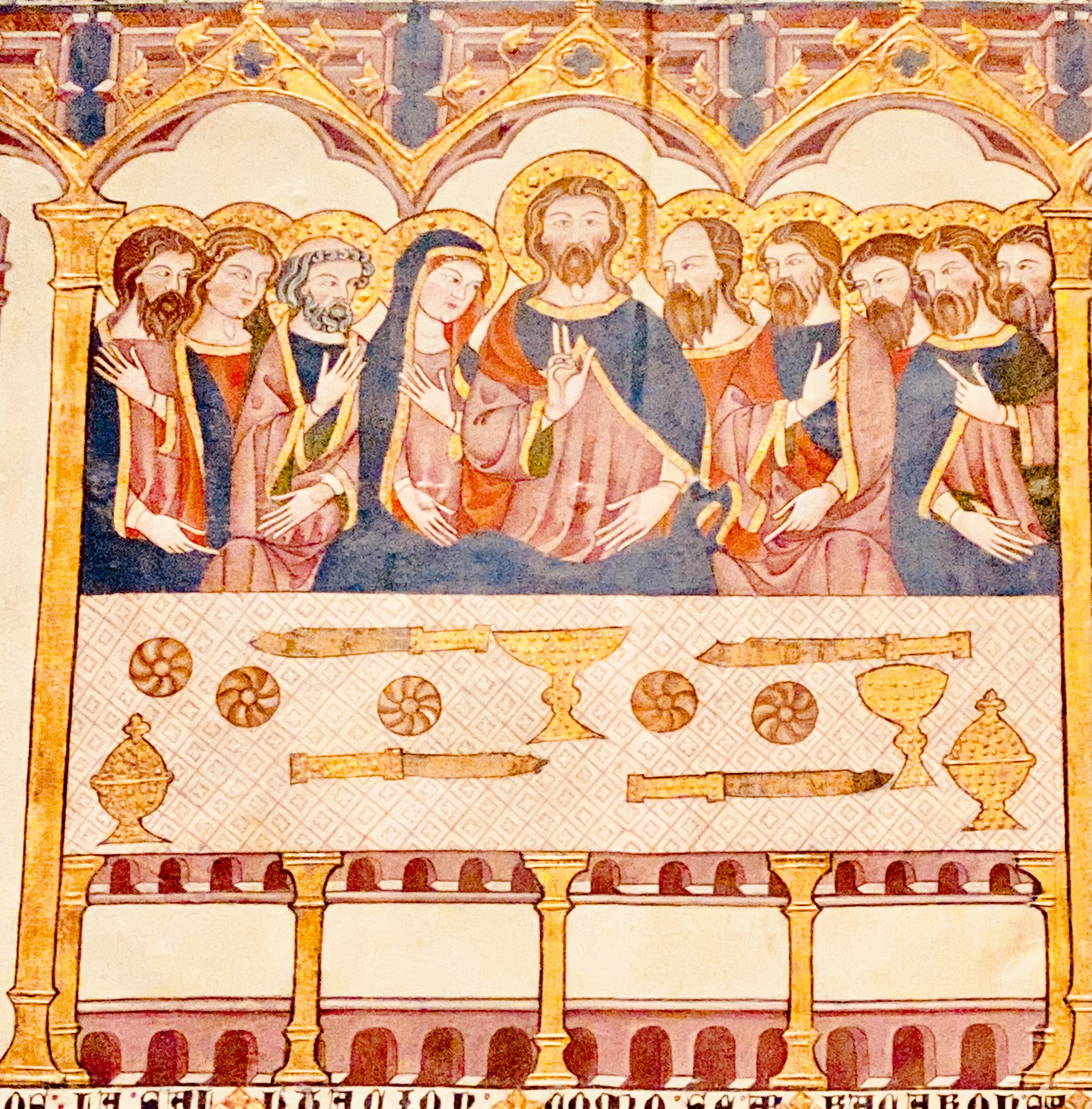
+The images in today’s post are of an altarpiece retable and frontal, commissioned for Pedro López de Ayala, made in Castile ca. 1396. It is housed in the Chicago Art Institute.
”We are witnesses of all that Jesus did…, and he commissioned us to preach to the people and testify that he is the one appointed by God as judge of the living and the dead.” [Acts of the Apostle 10].
Heading the list of astonishing things that we celebrate at Easter are the passion, death and resurrection of Jesus. As believers we confess these events as the centerpiece of human history, and the scriptures affirm that “once we were no people, but now we are the people of God.” So dramatic and so decisive was that event that no life, least of all our own, can be the same once we’ve heard and absorbed the message. After that we can never settle for being mere spectators in life. We can attend a sporting event, a concert, or a political speech, but none has the compelling message on which to build a life. Yet that’s what Easter is all about.
How can this possibly transform us? What difference can Easter make in your life and mine? Saint Paul in I Corinthians 5: 6 gives a hint of what’s possible. There he puts to us a rhetorical question that his first-century readers could answer easily. “Do you know that a little yeast leavens all the dough?” Sadly, that’s a biblical image that’s lost on most of us today, and the reason is obvious. Most of us have never seen yeast before. And that’s despite the fact that we eat its results almost every day. Because of that, many have no idea what a few grains of yeast mixed with water can do to a measure of flour.
It’s not our fault that we get most of our bread from factories that churn out truck-loads of loaves to be handed down the food chain. So we don’t realize what a tiny dose of leaven has accomplished. But if you’d like an idea, compare the unleavened wafer of bread we will receive in the Eucharist with a loaf of Saint John’s Bread. Only then will you have a sense of what Paul is talking about. Absent the yeast in our hearts, the preaching of Jesus will fall short of what’s truly possible within us. But if we’ve absorbed that yeast, then there are all sorts of possibilities for us. That’s exactly what Peter began to realize for himself. Without God little or nothing is possible. With God you and I can accomplish the unbelievable.
This past week I was the reader at morning prayer in the monastery, and one passage grabbed my attention as none of the other six could do. It was a reflection on the death of Jesus, by English writer Denise Cottrell-Boyce. Her initial focus was on what happened physically to Jesus as he began to die on the cross — as his body began the process of shutting down — as his body slowly transformed from a living and vital being into a carcass. As I prepared the text for public reading, I realized this might not go down well at 7:15 in the morning. But it was Good Friday morning, and that’s exactly what happened at the crucifixion. It happened to Jesus, until at last his breathing ceased and his heart stopped beating. Jesus was dead. Or was he?
Denise did not end her reflection with the last beat of the sacred heart of Jesus, because something happened that was nothing short of miraculous. Just as his mother and a teenage disciple who stood at the foot of the cross were about to give up completely, their hearts began to pick up on the heartbeat of Jesus. The redemptive act of Jesus on the cross had begun to transform the lives of first two and then a dozen and finally tens of millions of believers. One by one the rhythm of the heartbeat of Jesus has passed from one witness to another, until at last it’s found a home in our hearts as well.
In the final lines of her reflection Denise makes reference to the altar of repose, which features in the Holy Thursday liturgy. There, at the end of a procession from the main altar of the church, the priest places the remaining hosts in the tomb-like tabernacle, where they remain until they will nourish us at the end of the Good Friday liturgy.
Good Friday might have been the end of it all, but it wasn’t. Nor is Lent the end of it all, because Lent is merely the entree into a transformation that can go on for a lifetime. Saint Benedict picks up on that theme when he urges his monks to make their lives a Lenten observance. And we do that in many ways, but above all we do it whenever we celebrate the Eucharist.
On the cross Jesus offered up his very body and blood, and in the Eucharist we become the tabernacle of the still-vibrant heart of Jesus. As tabernacles, Denise takes pains to point out, we carry the life of Jesus to all whom we meet, to all whom we serve, and to all whom we are called to love.
The Easter event, then, is not some passive spectator sport. Instead it calls us to rise with the risen Lord. Leavened by the yeast that is his message, we are the tabernacles that carry Jesus to a world that is desperate for transformation and love. And if we find it astonishing that Peter could in a few days morph from skeptic into a herald of God’s Word, imagine the role that the Lord has in mind for you and for me. This Easter let us pray that we might bring to completion the wonderful work that the Lord has only just begun in us. Amen.
NOTES
+Today’s post is a transcription of the sermon that I delivered at the Easter Sunday Mass at Saint John’s Abbey. A large crowd of friends and other visitors joined us, which was gratifying to see.
+Last Monday and Tuesday much of the progress we had made toward spring was erased when nearly a foot of heavy wet snow ground activity to a halt. Still, we were consoled by the sight of the lake, which did not freeze.
+Eagle-eyed viewers of the Easter message of King Charles III were surprised to notice that in the background of one scene was an open volume of The Saint John’s Bible. It was on display at Lambeth Palace in London, in a large case made at the Abbey woodworking shop. You can access the king’s short address on YouTube.
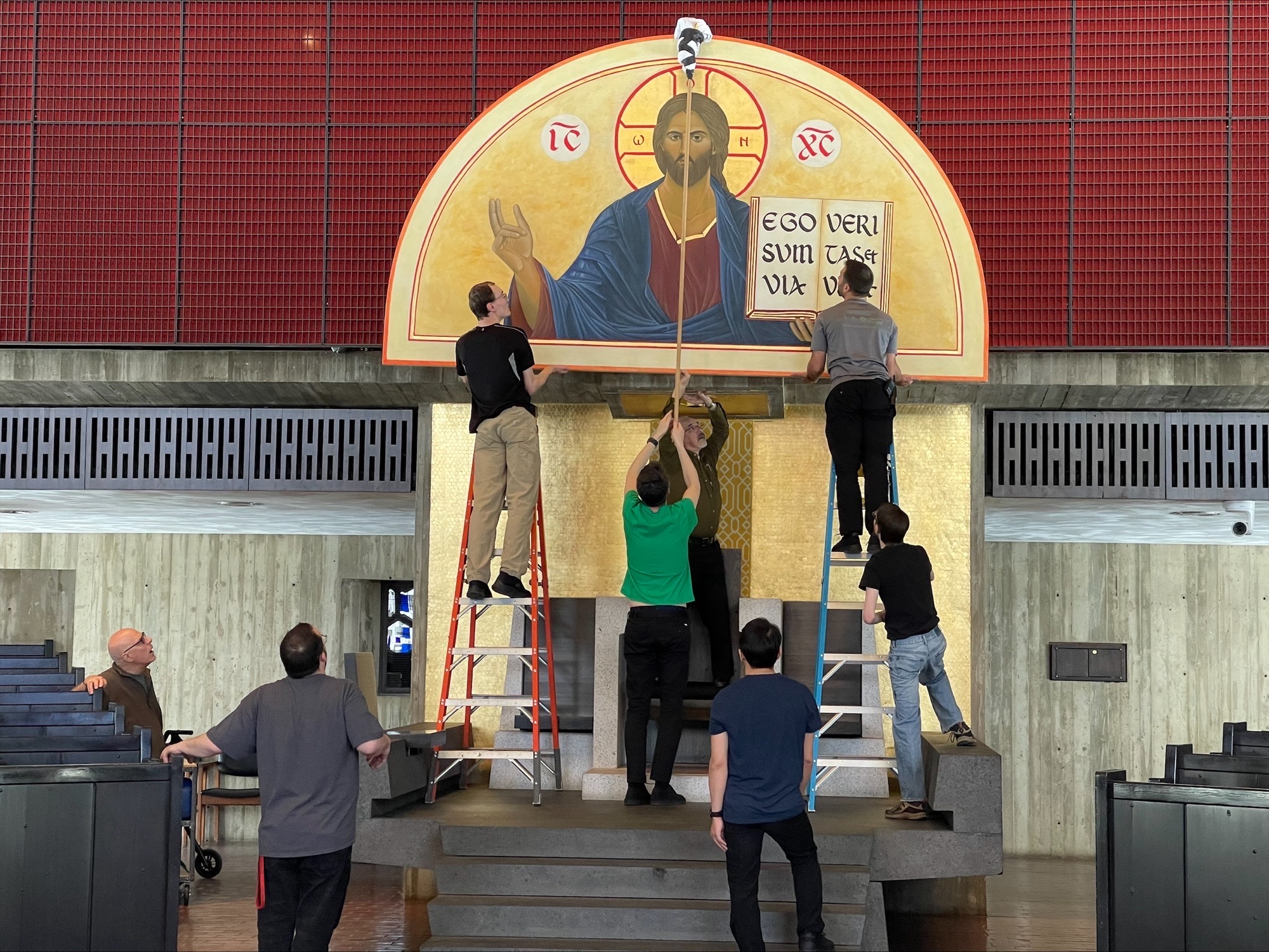
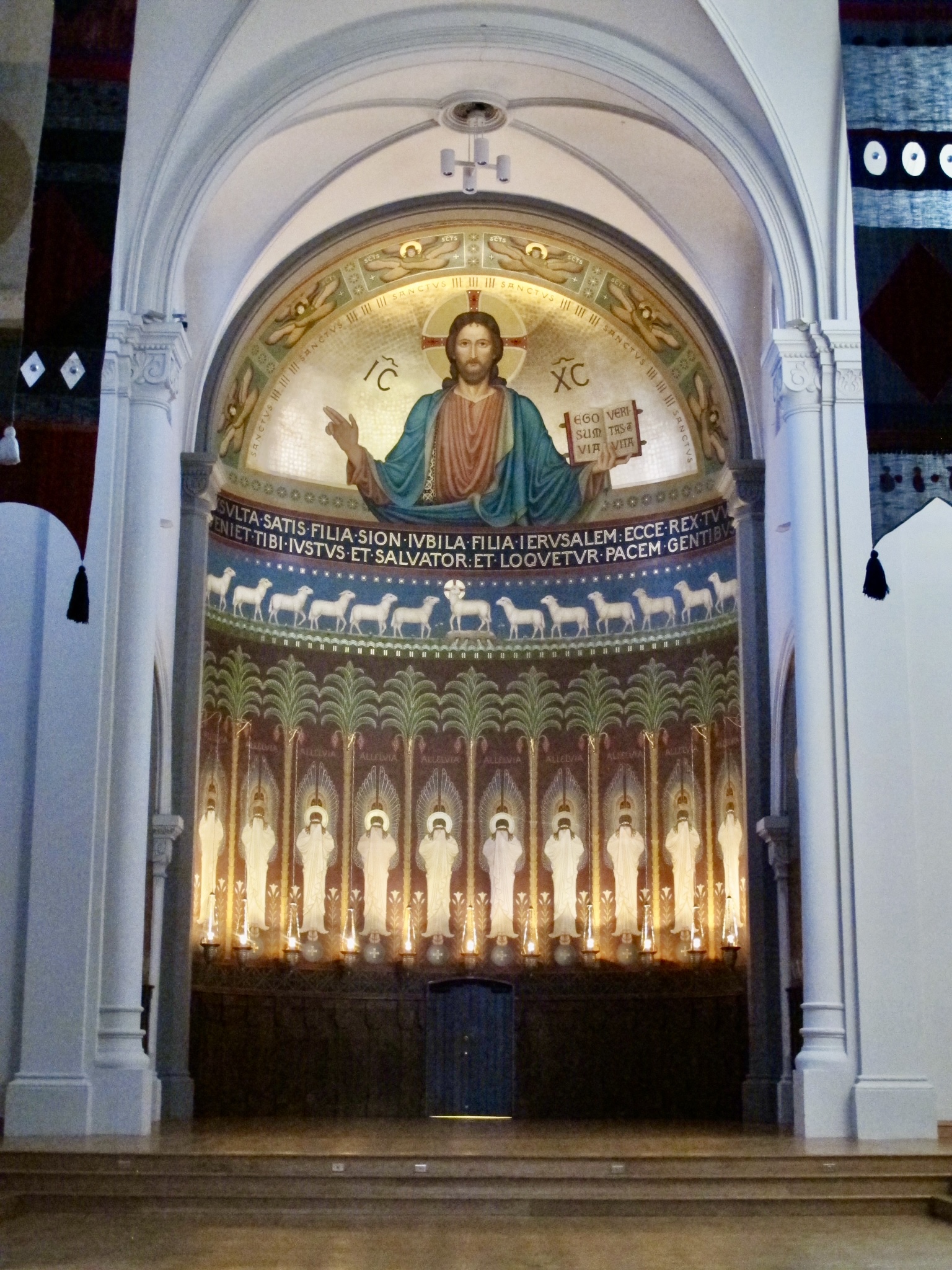
+The photos in today’s post show the interior of the Abbey church on Easter Sunday. I could not resist including the photo at bottom, taken by our confrere Brother Felix. It answers a question that has puzzled us monks for years: how many monks does it take to hoist up this mural in the church. Clearly the hard work was done by the committee of observers and advisors, standing by with ready counsel.
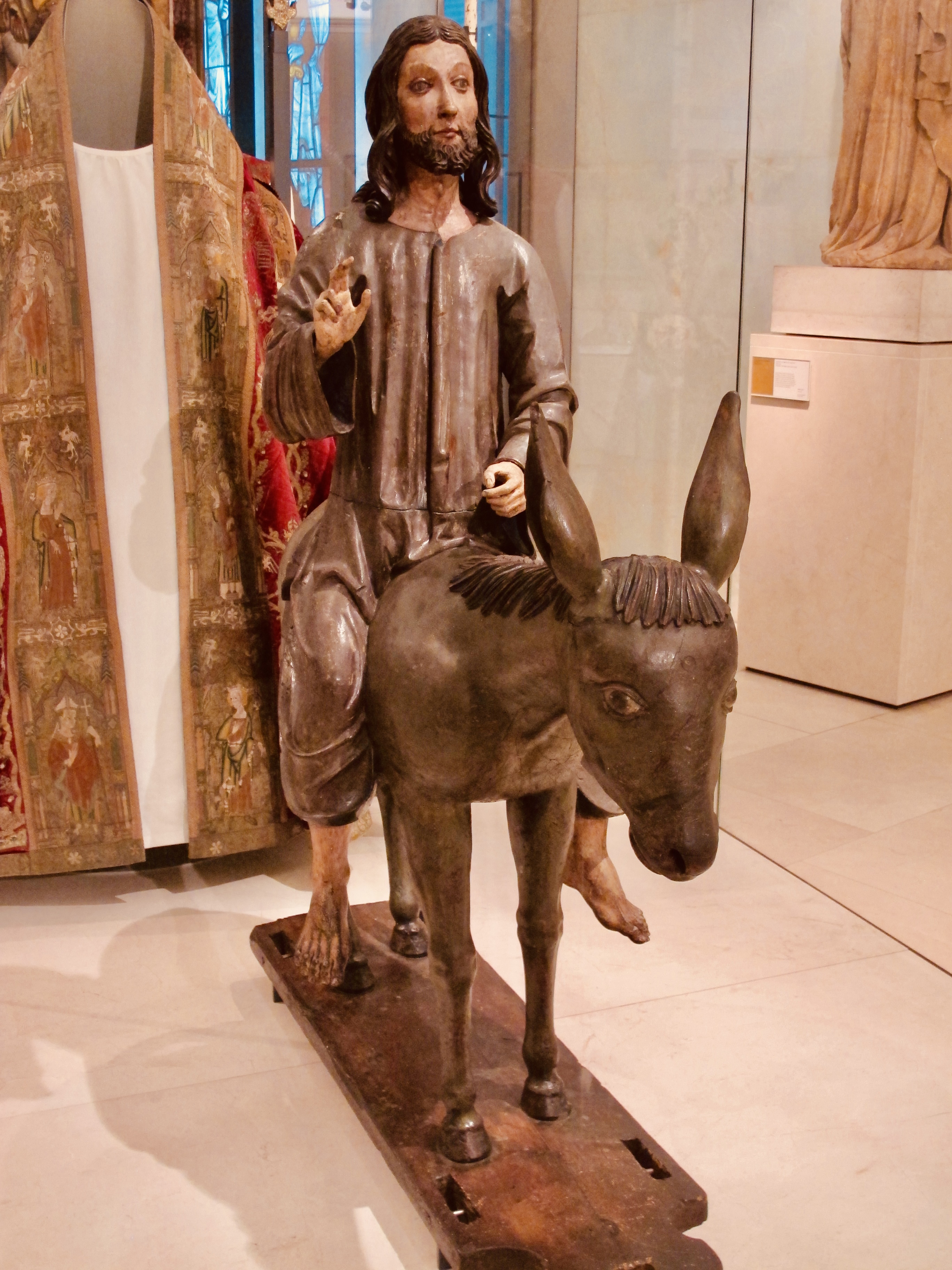
I met my first Palmesel on a trip to the Cloisters Museum in New York when I was in college. This particular palm donkey was a 15th-century creation, and in towns and villages throughout southern Germany these figures held places of honor in Palm Sunday processions. They made tangible the story of Palm Sunday. That day I realized that not all Palm Sunday processions are created equal.
This Palm Sunday one particular verse from the Passion narrative struck me as never before. As Jesus hung on the cross, witnesses taunted him with one bit of sarcasm: “…come down from the cross that we may see and believe.” That’s exactly what Jesus did, and it’s the message that disciples of Jesus have preached ever since.
Psychologists today cite the loneliness that grips so many, but I would suggest that it’s been part of the human experience ever since a sense of the self-conscious arose within us. Saint Augustine was certainly not the first to notice this, but his oft-repeated phrase reminds us of this phenomenon. “Our hearts are restless until they find their rest in thee.”
Whatever else it may have accomplished, the palm donkey that led processions in medieval Germany was and still is a reminder that Jesus did come down from the cross, and he does walk among us, even today. And if Emmanuel — God With Us is a phrase we recall at the Nativity, it’s consistent with the message of the passion, death and resurrection of Jesus. It’s our statement of faith that Jesus did come down from the cross, and he invites us to believe. He walks among us today — be it visibly in the faces of the poor and the sick and the wealthy and the powerful; or be it in the stirrings of the sacred that crop up deep inside us. And if it takes a carving of Jesus on a donkey to remind us of that, then so be it.
NOTES
+As is customary, our Palm Sunday procession at Saint John’s Abbey began in the Great Hall, where Abbot Douglas blessed the palms. Unlike previous years, the snow-storm outside forced us to find an alternate route through the first-floor cloister.
+Today’s post features photos of two 15th-century palm donkeys. The one at top is housed at the Cloisters Museum in New York, and the second is from the V & A Museum in London. At bottom is the Great Hall, where our Palm Sunday procession began.
I’ve given many retreats on the theme of Lent, so a recent day of reflection should have been no special challenge. Not so this time, however, because I’d spoken on Lent to this group many times before. Either I had to come up with something new, or pray that no one could recall what I’d said before. That’s why I opened with Cyril of Jerusalem.
There’s no reason that anyone in the room should know about Cyril of Jerusalem. But for liturgical historians he’s a big deal. A 4th-century pilgrim named Egeria happened to be in Jerusalem to witness the Holy Week and Easter liturgies led by Bishop Cyril, and hers is the earliest detailed record we have of all that. Her description has long fascinated me, and so I hoped no eyes would glaze over at my reference to her.
The big take-away from Egeria’s eye-witness account was the seamless progression of several days of liturgy. Stitched together by a parade of scripture passages, the liturgy recounts the story of creation and salvation history, culminating in the passion, death and resurrection of Jesus. But if Cyril’s congregation thought that by Easter they’d heard all there was to hear, Cyril reminded them that they were just getting started. The Acts of the Apostles took center stage once Easter had passed, and that text deals with the big question that confronted the apostles: “What do we do now?”
What they did was let the Holy Spirit guide them. And as they confronted one crisis and crossroad after another, they finally realized they were no longer Jewish. By the end of the Acts of the Apostles they called themselves Christian.
That’s why we should never think of Lent as a stand-alone season. When it’s over it’s not really over, because the change in us has only just begun. Lent is merely the preamble to a lifetime of reflection on Jesus and the sacred duties to which he calls each of us.
Thanks to Cyril of Jerusalem and Egeria of Spain I was able to draw one more insight from these coming holy days. Put simply, the disciples lived the first Holy Week and Easter, and in the 4th century Bishop Cyril spent days reflecting on its meaning for him and his congregation. We should do no less.
If Cyril’s listeners took it all in seriously, so should we. The sacred liturgies speak of Jesus as the turning point in human history and as the light of our lives. Just as the Easter candle pierces the darkness of the Easter Vigil, so our lives should do the same in a world hungry for meaning. That’s why we should take part in these liturgies as much as we are able. Without us the light of the Easter candle can burn dimly. With us, the light can pierce any darkness.
NOTES
+On March 11th I presided at the abbey Mass.
+On March 16th I gave a day of reflection to area members of the Order of Malta in Seattle, WA. Through many years I’ve gotten to know many of the members, and it was a delight to join them for that day.
+Brother Walter declared the collection of maple sap this season to be a great success. For one thing, volunteers collected a record 23,515 gallons of sap and produced a record 577 gallons of maple syrup. Meanwhile, improved equipment reduced the amount of wood necessary to cook it by 25%.
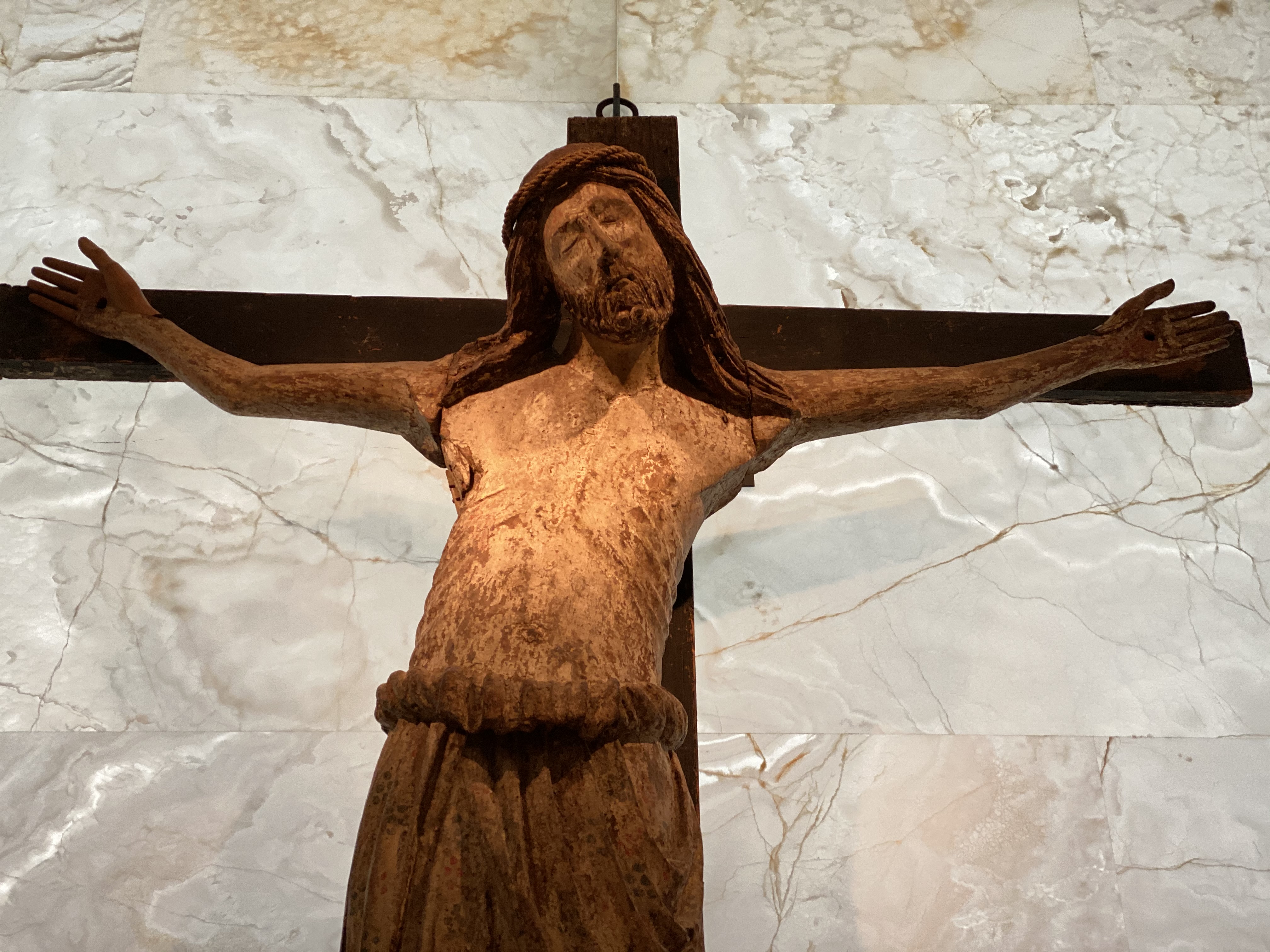
+The photo at top shows Christ on the Cross. Crafted most likely in Tuscany ca. 1250, it is now housed in the V & A in London. The next two photos show a liturgical comb detailing several scenes from the life of Jesus. Made of ivory ca. 1130 in St. Albans in England, it is also is housed in the V & A.
A recurring theme in the gospels deals with those who thought they knew Jesus but really didn’t. Because they knew where he came from and who Mary and Joseph were, they could not imagine any potential in Jesus. And so, whenever Jesus met such people, he could work no wonders among them.
Sometimes we are those people. We are the people who typecast Jesus, perhaps because of our long familiarity with him. We may think we know him, but like the neighbors of Jesus we sometimes cannot bring ourselves to let him work among us. That can be true even for us monks, despite our conditioning to see the face of Christ in our brothers and sisters. The results are predictable. We see little or no potential for the extraordinary in our fellow monks, in our colleagues at work, or in our guests. We give them no room to grow or reach their potential. Even worse, sometimes we do the very same thing to ourselves.
I sometimes marvel at the excuses we use to thwart the stirrings of God within us. “We’ve never done that before” is a phrase that gets a lot of use, and it makes us bedfellows with those who could see no glimpse of the possibilities in Jesus.
One of the most frustrating experiences for Jesus had to be those times when he could work no wonders in a particular village or in a particular person. God forbid that we ever slip into that mode, but we all do it and we know we do it. And so one prayer for Lent might be to plead for openness to the stirrings of Jesus among us. Let us not be those who —at the end of the day — have absolutely no recollection of Jesus at work among us. Let us pray instead for open eyes and ears, and especially for the imagination to let Jesus flourish within our daily routine. If we can do that, then Easter might very well take on a whole new meaning for us.
NOTES
+On March 4th the ice went out from Lake Sagatagan. It is the earliest that anyone can recall, but it puts into perspective the tapping of the maple trees in late January — much earlier than usual. That effort continues, and the aroma from cooking the sap continues to reward hikers in the woods.
+From March 3rd through the 7th I participated in the annual retreat of the members of the Subpriory of Our Lady of Philermo of the Order of Malta. It took place at the Franciscan Renewal Center in Phoenix. It’s a place long familiar to me, and not just because it houses a set of the Heritage Edition of The Saint John’s Bible.
+On March 11th I presided at the Abbey Mass, and today’s post is a variation of the sermon I delivered. It is based on John 4: 43-54, the gospel for the day.
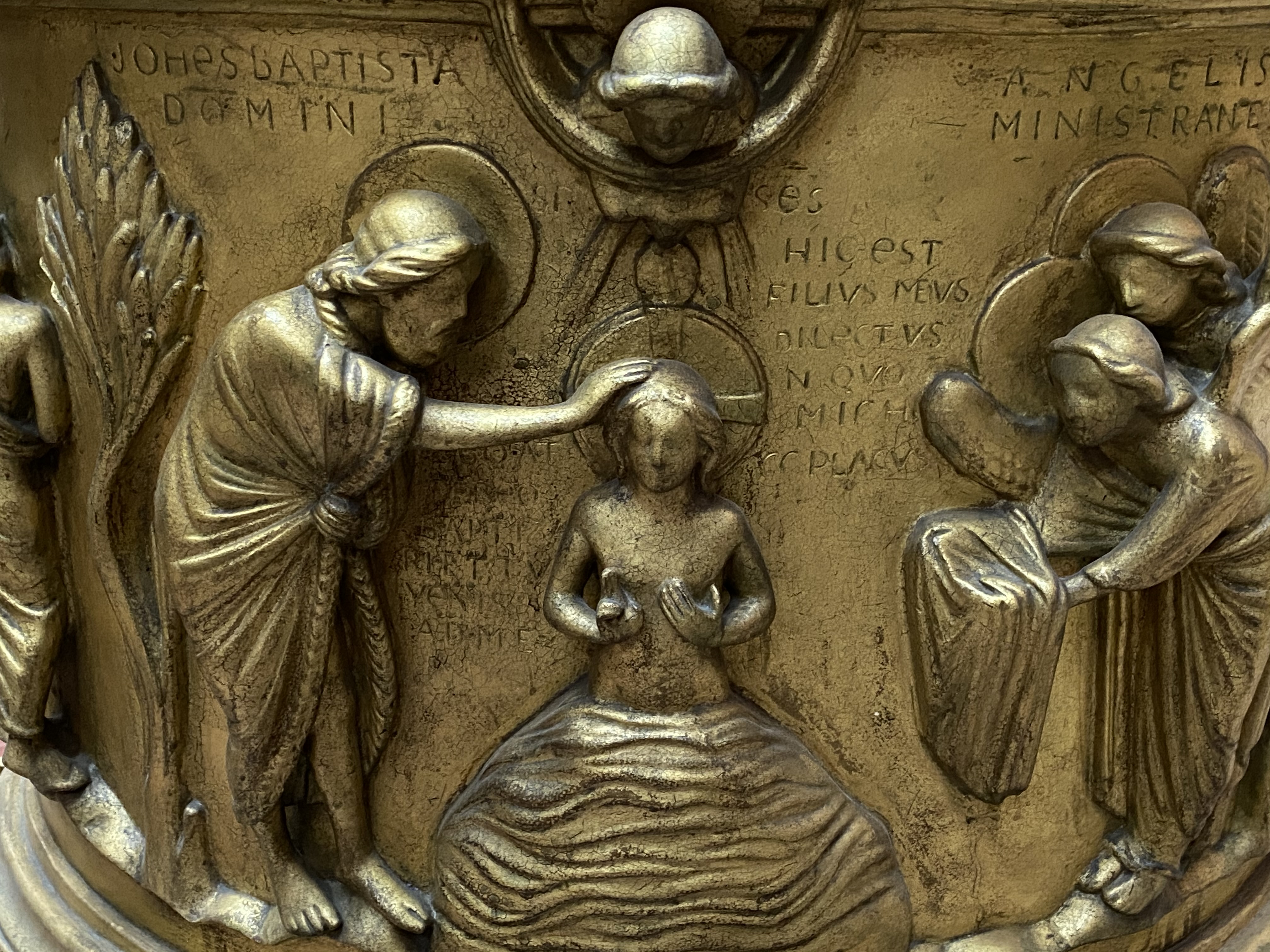
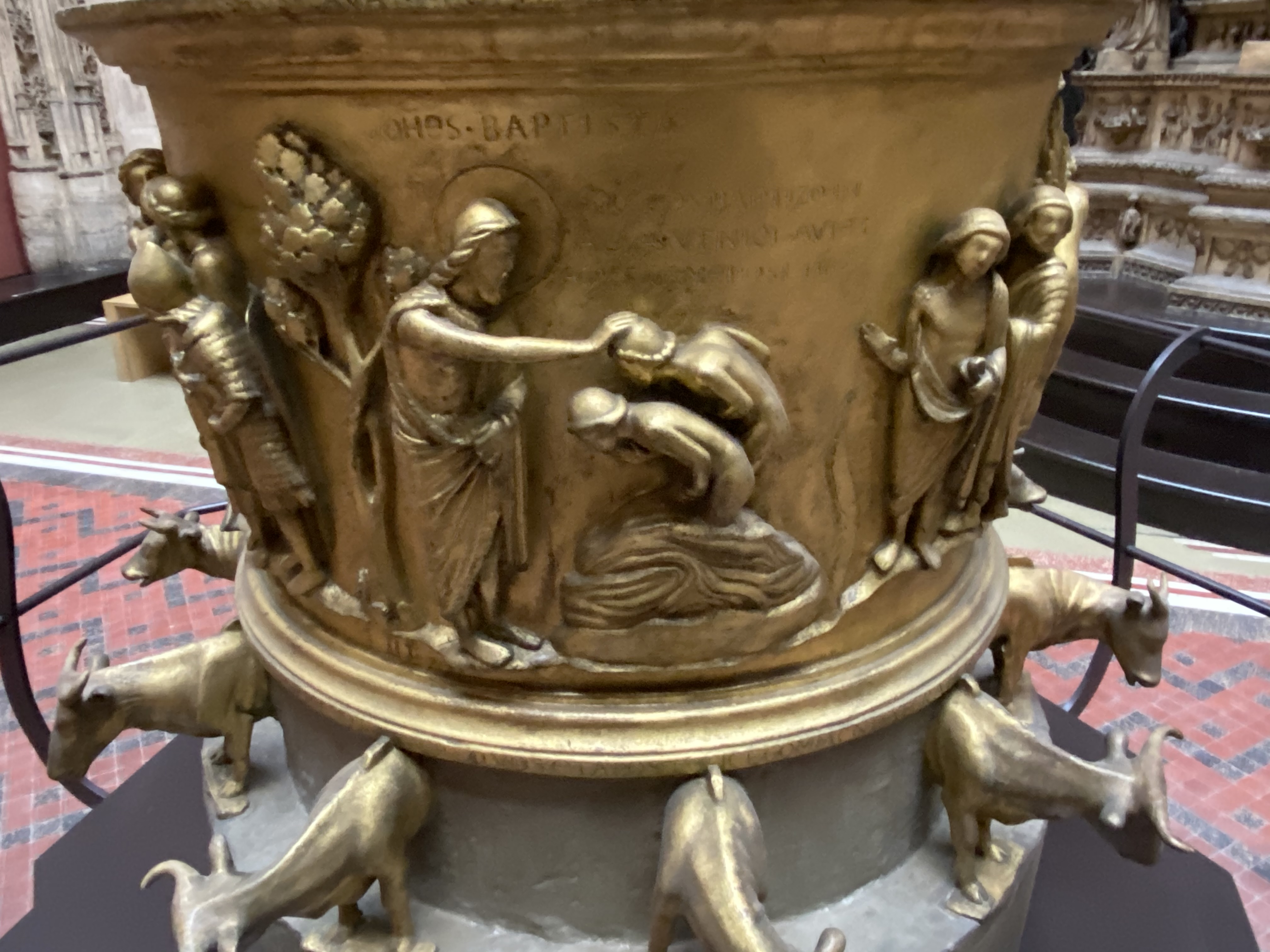
+Among those who could easily see the stirrings of God in others were John the Baptist and Jesus. The photos in today’s post show copies of panels from a bronze baptismal font, cast ca. 1107 for the church of Notre-Dame-aux-Fonts in Belgium. These 19th-century castings are housed in the V & A Museum in London.
Perhaps you may have seen the cartoon in which Moses stands at the head of a column of Israelites, stalled in the desert. It doesn’t look good as he puzzles over his GPS, and what he reads is not what he had expected. “‘Estimated time of arrival: 40 years.’ That can’t be right!”
It’s a good thing the Israelites had no idea how true that estimate would be. It’s also good that they had no inkling of the privations they would endure or the dangers they would confront. Had they known, they might never have left Egypt. But most of all, had they known God’s short-term will for them, some would certainly have halted along the way to comfort themselves with the golden calf.
Theirs was a harrowing journey, but then again Yahweh had never promised them a pleasant seaside vacation. Instead, dramatic change was to be their lot. They had left Egypt as a ragtag group of former slaves, but in the course of forty years they would become God’s people. They would also become an entirely new people, and not just metaphorically. Most of the people who left Egypt — including Moses — would never set foot on the promised land. That privilege would fall to their sons and daughters.
”Forty years” may or may not have been an accurate measure of their time in the desert, but it also came to mean “a long time.” So it was that Jesus spent forty days in the desert, and it’s how we measure the time for Lent. And whether it means a literal forty days or a “long time,” it has come to mean an interval during which important things happen to us. We change. We grow. We become new people.
During his forty days in the desert Jesus grew in wisdom and in his awareness of what God his father had called him to do. In that light, what might the forty days of Lent mean for us? First, I think it’s good to resist the urge to reduce it to some sort of endurance contest. Certainly there ought to be an element of self-denial in our Lenten observance, but there’s more. Like the Israelites and Jesus in the desert, Lent for us ought to involve an exploration of who we are as people. To what are we called? What of permanent value might we carry forward with us when we reach our Easter moment?
Saint Benedict urges his monks to think of their lives as a Lenten observance. In this case “forty years” symbolize the lifetime we’ve been given to work with. During that lifetime we make both painful and joyful discoveries. It’s a journey of insight, during which we discover who we really are and for what sacred duties the Lord has set us apart.
The forty days of Lent are a metaphor of our years of mature life. If neither end up becoming a romp at the seashore, that’s okay. They are supposed to be something far more important. Each ought to be the trip of a lifetime.
NOTES
+Most of the last week was a blur of meetings. However, on March 3rd I began a five-day retreat with members of the Subpriory of Our Lady of Philermo of the Order of Malta. The retreat takes place at the Franciscan Renewal Center in Phoenix, AZ.
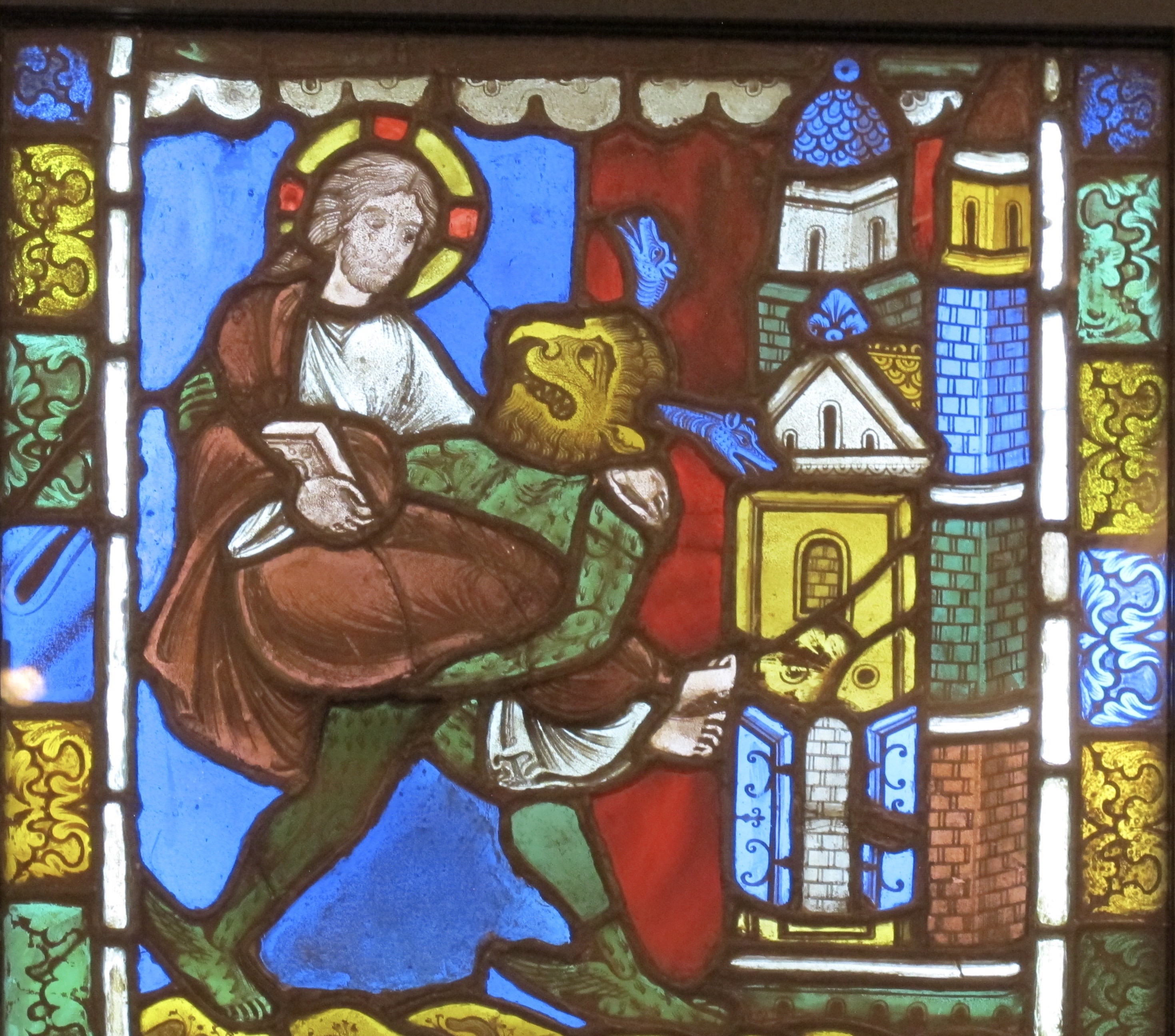
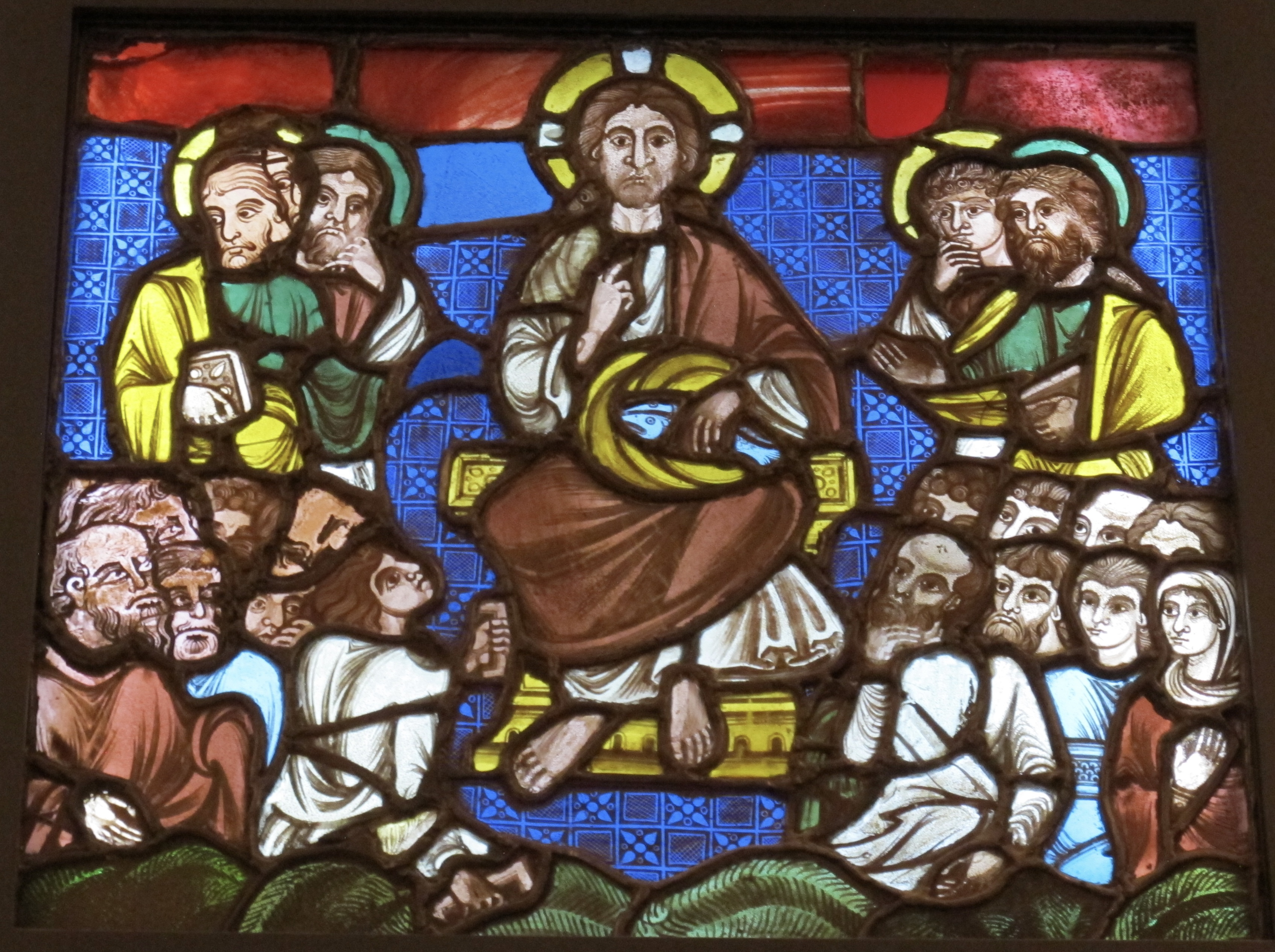
+The photos in today’s post come from a series of 12th-century glass windows depicting the temptation of Jesus in the desert. Originally crafted for a church in Troyes in France, they now reside in the V & A Museum in London.
Normally I find nothing humorous at all about the book of Deuteronomy. However, in a recent meditation a ray of whimsy hit me, and the lesson was this. I still have a lot to discover when it comes to the Bible, and in the Bible there is plenty of fine print.
In this case Deuteronomy 26: 16-19 recounts a conversation between God and the people of Israel. Near the end of it God makes it clear that they need to observe all the statutes and decrees, and not just some of them. Then the question popped up. Knowing human nature, how long did it take for God and the Israelites to pound out the details of this agreement? Would God have an easier time driving a bargain with the monastic chapter? Probably not, for the simple reason that we monks can edit the daylights out of any document in front of us.
This brings up an important point to mull over. With all the legal language we find in Deuteronomy and later in church law and tradition, it’s easy to slip into the mindset that if we do our part of the deal, then God is somehow bound by the terms of the agreement. In the process we lose sight of the fact that the statutes and decrees are not ends in themselves. They are merely ingredients for a long and lasting and beautiful relationship with God.
Given that, we should not be surprised by the answer Jesus gives us when we ask what we must do to be saved. The answer is short and sweet. We must love the Lord our God with all our heart, our mind and our soul; and our neighbor as ourself. Any answer short of that simply misses the point. And if our first impulse might be “Yikes, why so much?”, then we should wonder why we would settle for anything less.
NOTES
+During the last week I had an overly full schedule of meetings, but the best of them was an annual health review with my doctor. I was surprised to discover that apparently I have better health than I deserve. Clearly God works in mysterious ways, but who am I to question why?
+This last weekend the abbey guest house hosted a group of deacon candidates from the Archdiocese of Saint Paul & Minneapolis. We were happy to have them join us for Mass and the Liturgy of the Hours.
+During Lent we scale back a bit on some of our congregational singing. Nevertheless the abbey church hosted an organ and cello recital on Friday evening and a concert of sacred music on Sunday.
+On 24 February I presided at the abbey Mass, and today’s post is a slight edit of the sermon that I delivered.
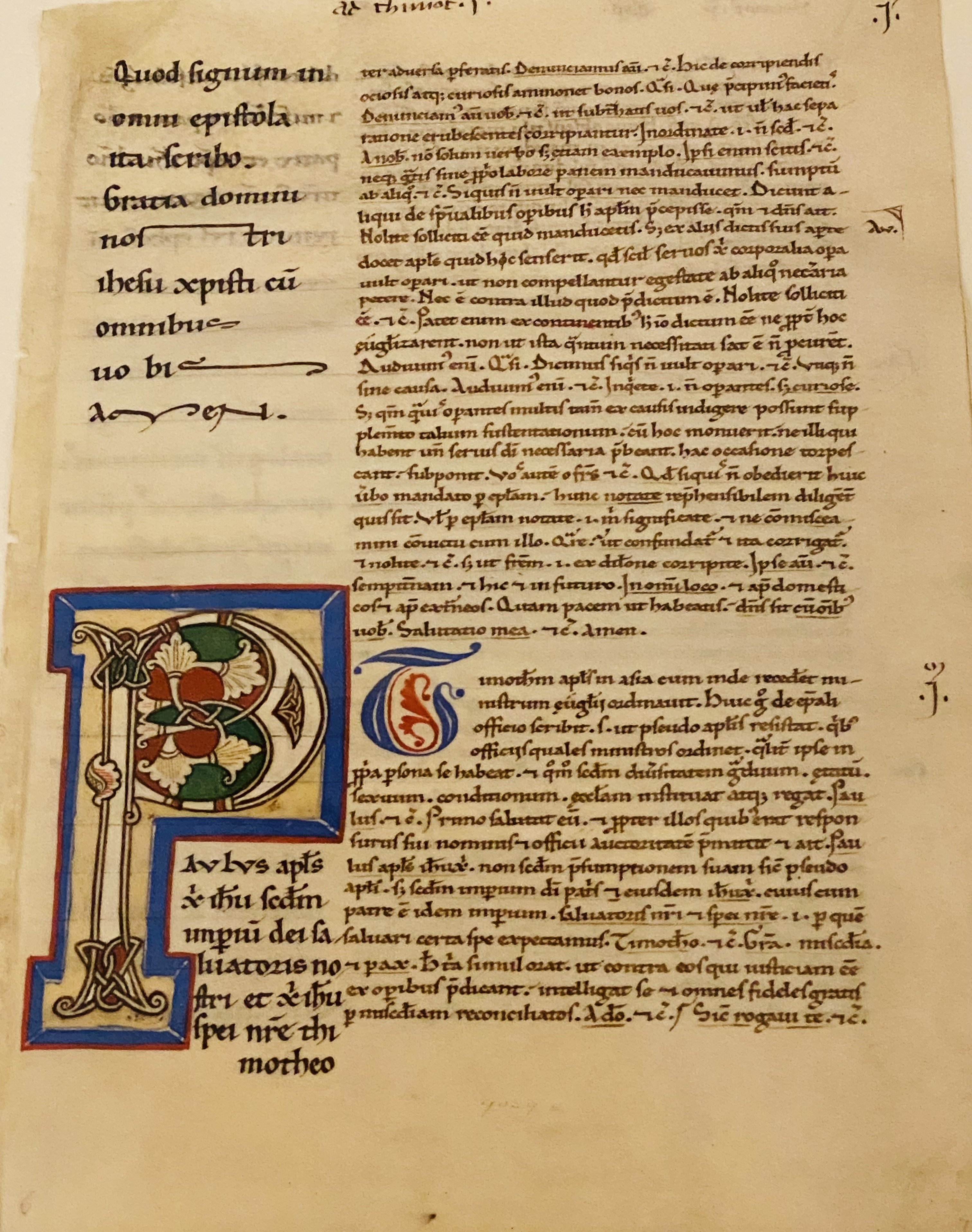
+The top photo in today’s post is a page from a commentary by Gilbert de la Porée on the Letters of Paul, copied ca. 1140-50. The larger print shows text from Saint Paul, while the fine print is Gilbert’s commentary. Below that is a leaf from a Bible, ca. 1260, crafted in the Netherlands. Both of these are housed at the V & A Museum in London. At bottom is a decommissioned 18th-century Torah Scroll, housed in Alcuin Library at Saint John’s University. As one can easily note, there’s a lifetime of mulling to be done there.
For much of my life Lent has been a puzzle. From childhood I have vivid memories of solemn Ash Wednesday services and simple penances like giving up candy. Much of this was confirmed in the monastery, where Saint Benedict urges us monks to make our lives a Lenten observance. He also encourages us to embrace some sort of self-denial, though he tempers that with the need to secure the abbot’s permission. In fact he discourages us from being too blatant about it, lest we transform ourselves into paragons of virtue. That warning was my first hint that Lent in the monastery might be more than I had imagined.
In an echo of Ash Wednesday, Saint Benedict asks us monks to keep death daily before our eyes. That can appear to be an invitation to depression and despair. But can it really be that Benedict wants monks to live in fear of the end and the loss of everything they hold dear? I hope not.
Benedict tempers this with the command to see Christ at every turn and at every hour. The abbot, for example, holds the place of Christ in the monastery. What monks do for the elderly and sick they do for Christ. In the faces of the young monks and the seniors we should glimpse the face of Christ. Guests we should treat as if they were Christ come to visit. Adding to this more positive message is Benedict’s request that we read some spiritual book during Lent. Given all this, is Lent supposed to be penance or enlightenment? What’s a monk to do?
It took me a while to realize the nuanced message that Benedict leaves us. Despite the ashes and the small penances we might take on during Lent, what he really prescribes is a life of intensity. It’s a life in which we pause and for a few weeks take absolutely nothing for granted. We’ve been given life — did we deserve it by some sort of divine right? Do we deserve family and friends? Do we deserve the presence of the Lord, walking alongside us every step of the way? Of course we don’t deserve any of this. Yet these gifts are ours, and so are the many others God has given to us.
For my Lenten observance this year I’ve decided to begin each day with a prayer of thanksgiving for one of my blessings. At the very least I may discover in the course of Lent how richly blessed I’ve been. But in a nod to the need to do something concrete — something that will give me a sense of personal accomplishment — I plan to finish the big fat book that I stalled out on three months ago. Will that be penance or an exercise in enlightenment? I won’t know until the end.
NOTES
+On February 14th we began the season of Lent with the bestowal of ashes. Between student and monastery Masses, as well as the liturgy of the hours that ushered us into the new season, the church got a good workout that day.
+Normally the abbot gives conferences to the community on Tuesday evening, as part of our cycle of community meetings. However, at the beginning of Lent the abbot delivers that conference on Ash Wednesday, after the completion of evening prayer.
+As residents of the upper Midwest know, this has been a rather temperate winter, so far at least. As a result, the tapping of our maple trees to make syrup began much earlier than usual. In fact it is the earliest we’ve ever started the process. So a walk in the woods these days rewards a hiker with the aroma of maple sap being cooked over a wood fire.
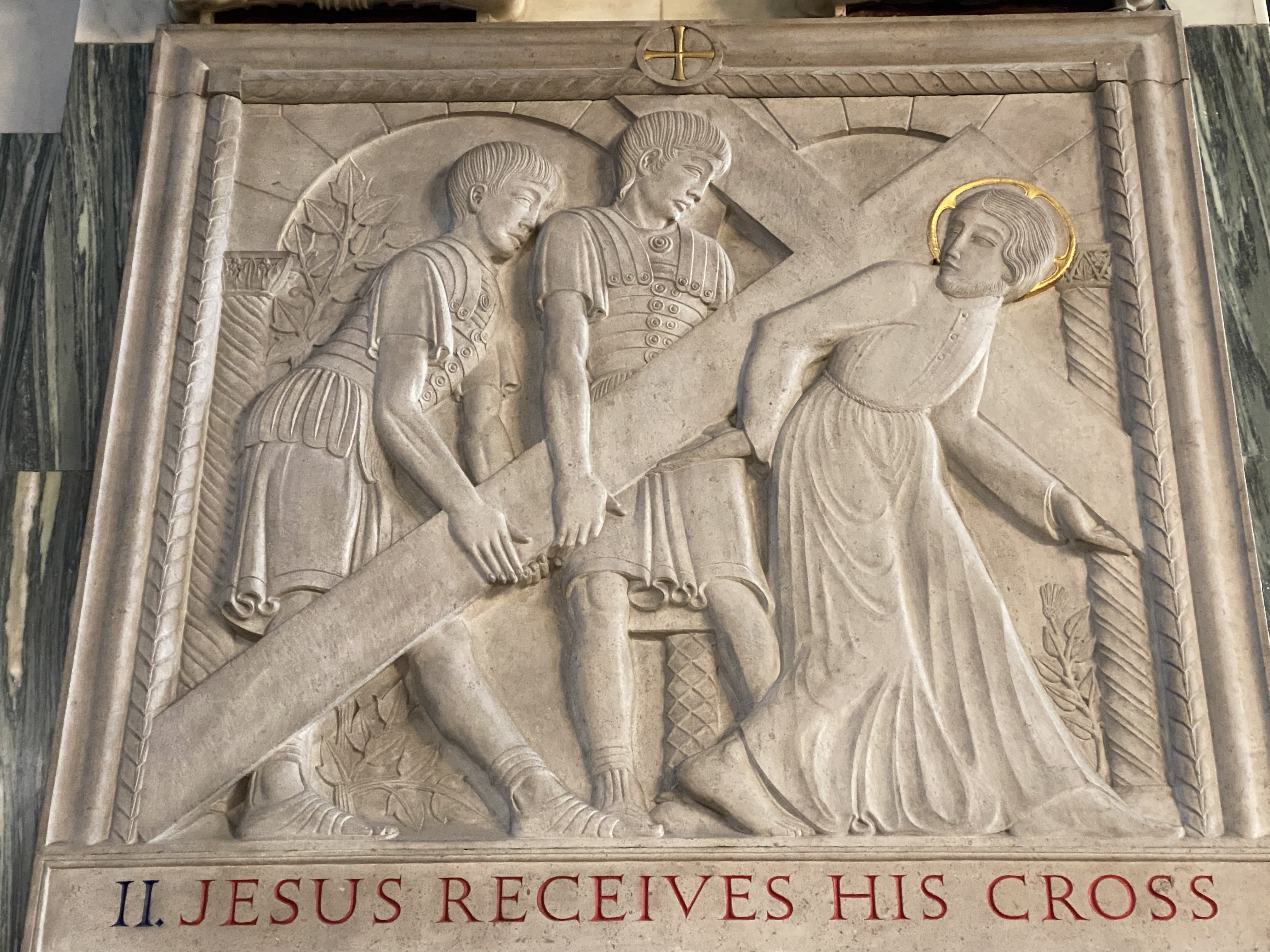
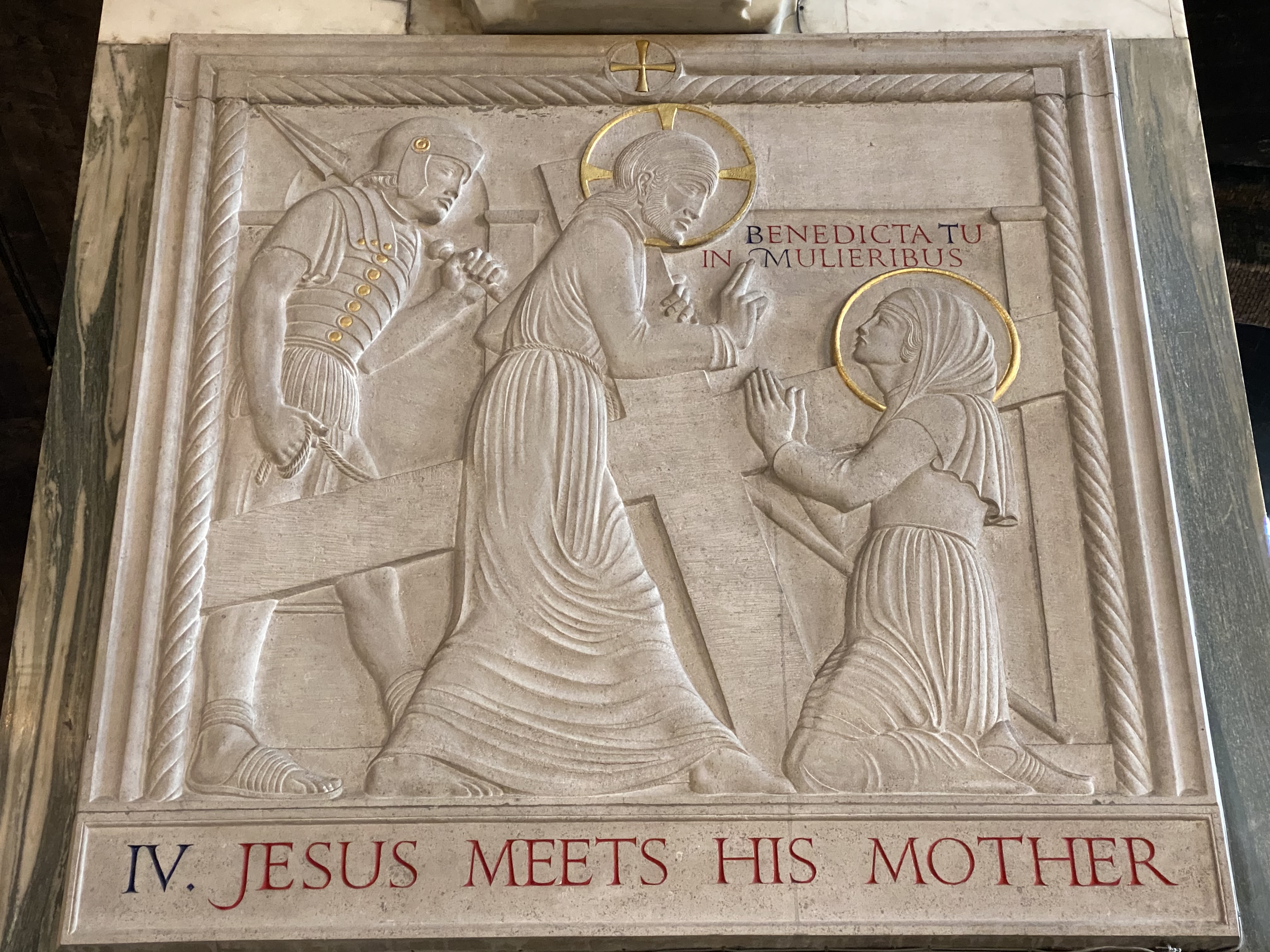
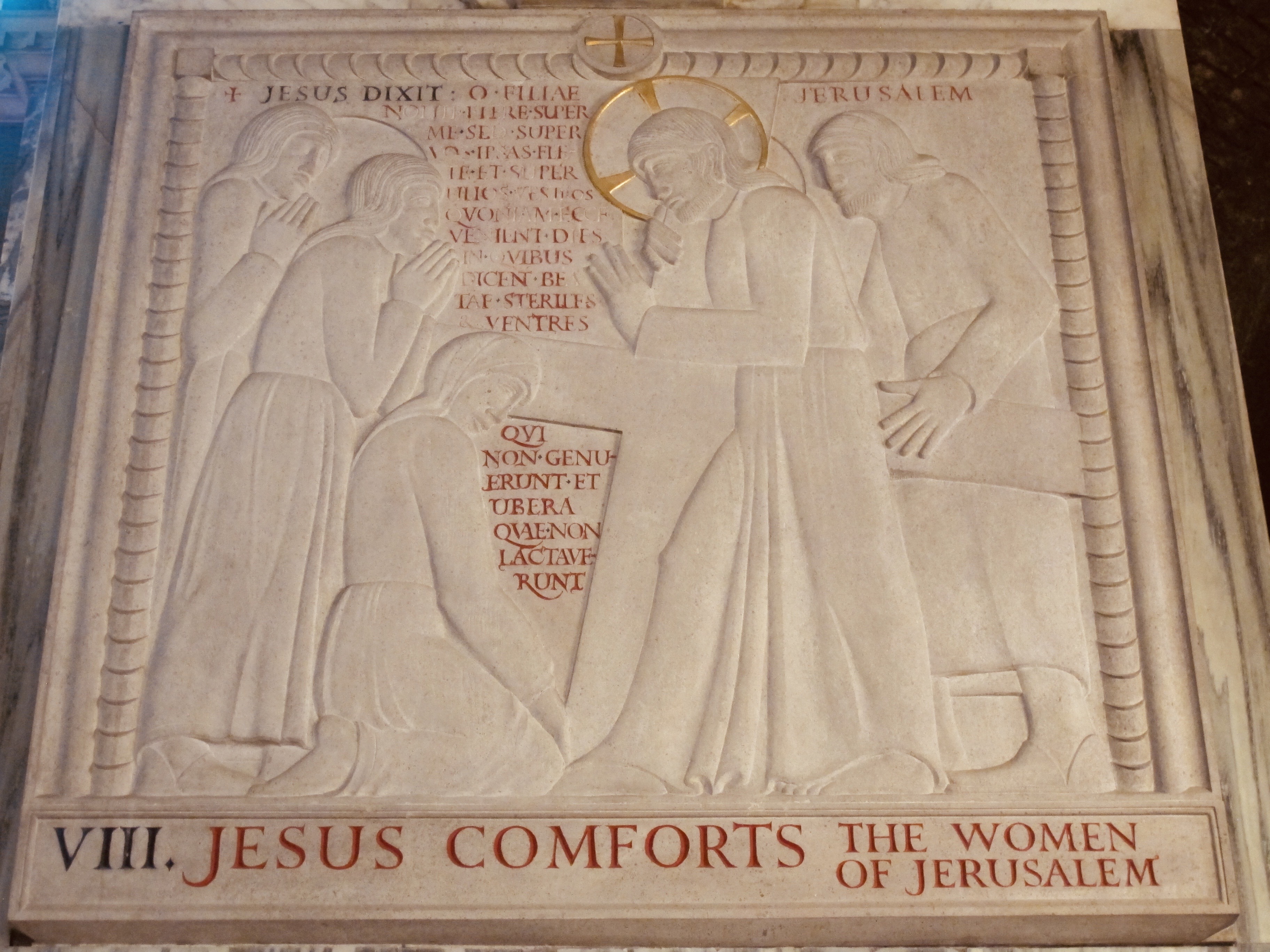
+I’ve long appreciated the wide range of artistic renditions of the Stations of the Cross, and my favorite among modern ones is the work of Eric Gill. They are housed in Westminster Cathedral, the Catholic cathedral in London. This artistic meditation on the gospel narrative is a good way to begin a Lenten observance.














 A Monk's Chronicle